
Gear & Upgrading
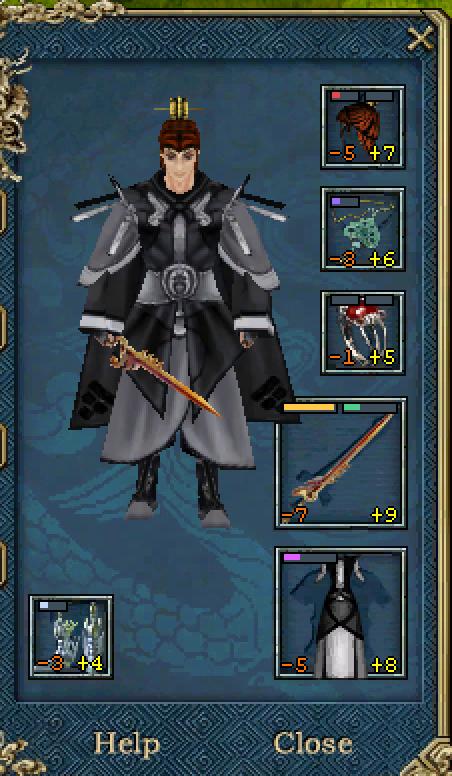
Each slot is sized for what belongs in it, and every piece carries the same marks your backpack uses — see reading an item.
Gear is the other half of progression alongside levels. There are several ways to make a piece
stronger — all tuned as part of a healthy, audited economy.
Quality
Items come in quality tiers — higher quality means better base stats. You'll find them from
drops, vendors and events (see Hunting & Loot).
+Upgrading
Raising an item's plus level is the headline upgrade, and there are three people who will do it
— the difference between them is risk, and it is worth understanding before you spend anything.
| Who | Where | What they do | Costs | Can it fail? |
|---|---|---|---|---|
| ArtisanWind | Twin City | Opens his own forge — drag the piece and one material in | 1 Meteor (level) or 1 DragonBall (quality) per attempt | Yes. The material is spent either way, and a failure costs the piece half its current durability |
| MagicArtisan | Market | Guaranteed upgrade, no roll at all | More Meteors or DragonBalls — roughly what the gamble would have cost you on average | No |
| WeaponMaster | Market | The only one who goes past level 120 | 1 DragonBall per step, flat | No |
So ArtisanWind is the cheap shot and MagicArtisan is the insurance: Wind charges one material and
sometimes eats it, while MagicArtisan charges what the attempt is worth and never fails. Neither
of them can touch gear that would demand level 120 of you — that wall is where WeaponMaster starts,
and his price stays flat however far past it you go.
All three want the piece worn and fully repaired before they will look at it (ArtisanWind's
window takes it from your bag instead).
Nobody spends anything until you say yes. Pick the slot and the artisan quotes it first: what the
piece is, what it becomes, what that costs and how many you are carrying — "Your OxhideBoots (level
10) becomes DeerskinBoots (level 20). That costs 2 Meteors; you carry 0." If it cannot be done, the
quote says exactly why (not worn, top of its line, the next form out-levels you, past the wall, or
short by N). The Yes button is the only thing that pays.
A MeteorScroll counts as 10 Meteors and a box as 100 (DragonBalls the same), and so does what
you have banked with Millionaire Lee. The artisan pays the bill in this order and
tells you the split before you say yes: loose pieces in your bag, then your bank balance (a debit,
nothing to carry back), then a scroll opened for you with the change handed back as loose Meteors,
then a box. Change needs bag room, so with a full bag the quote asks you to make space first rather
than opening anything — "your bag is 11 slots short of holding it" — and touches nothing.
GodlyArtisan, also in the Market, is the odd one out — he does not upgrade anything. He restores
the maximum durability a piece can hold, which is the number that quietly erodes and which no
blacksmith touches. See Durability & repair below.
Gems & sockets
Gems are not Meteors or DragonBalls. A gem — DragonGem, PhoenixGem, TortoiseGem and the
rest — is a coloured stone that sits in a socket and grants an effect while it is there.
Meteors and DragonBalls are upgrade materials: they are consumed by an upgrade and never
go into a socket. The two are easy to confuse because both are small stones in your bag and both
get spent on gear — but nothing takes a Meteor out of a socket, because one never went in.
Gear can hold gems in its sockets for extra effects. Gems come in tiers and can be composed
into higher ones, which costs silver — one of the economy's gold sinks.
Where sockets come from
Most weapons aren't born with sockets, though roughly one dropped weapon in five already has one
(about 5% arrive with two). Otherwise you open them, and there are three ways.
By paying — weapons only, and from one craftsman. ArtisanOu on Bird Island drills the
weapon in your hand: 1 DragonBall for the first socket, 5 for the second (the second needs
the first). Equip the weapon before you ask. He is the only one who does this — it is his trade, and
it is worth the trip.
Armour and accessories are not sold sockets. There is no shop for them, on purpose — paying a
dozen DragonBalls a slot, six slots deep, for a stat line you never see is a chore, not a choice. An
armour socket is something you find or get lucky into, and a weapon socket is the one worth a real
decision. Anything already socketed stays exactly as it is.
By luck, on any upgrade — this one works on everything, armour included. Every successful
upgrade rolls a small chance to open a socket:
| upgrading with | opens the 1st socket | opens the 2nd |
|---|---|---|
| Meteor (level upgrade) | 1.5% | 0.75% |
| DragonBall (quality upgrade) | 2% | 1% |
The second socket can only appear on a piece that already has a first one.
By certainty, with a +1 material. A Meteor or DragonBall carrying a +1 is a different tool
from an ordinary one, and this is the only thing that plus does:
- a +1 Meteor guarantees the first socket
- a +1 DragonBall guarantees the second — on a weapon that already has a first
The guarantee holds even if the upgrade roll itself fails, so a +1 is never wasted. Treat one as a
socket tool you're saving for a weapon you mean to keep, not as spending money — and be careful not
to hand it over as ordinary upgrade fuel, because in the bag it looks like any other Meteor.
Both come from hunting the Marked — see Hunting & Loot:
- a +1 Meteor is the Master Hunter capstone, paid once by the Trophy Keeper for felling every
one of the Marked - a +1 DragonBall is a rare bonus when you bring a Mythic trophy in for its bounty
There is no other source. They are not sold, and they do not drop from ordinary monsters.
How to actually do it
Sockets come from ArtisanWind's forge window in Twin City — the one you drag items into. They do
not come from any artisan's dialogue options; those run a different path that ignores the +1
entirely.
Three things the window will refuse, quietly, if you get them wrong:
- the weapon must be in your bag, not equipped
- the material must be in your bag too
- the weapon must be at full durability — repair it first
Then drop the weapon and the Meteor (or DragonBall) into the window and upgrade as normal.
Reading an item at a glance
You don't have to hover every slot. Each item cell carries its own marks — a quality field behind the
art, the upgrade level, the blessing, and a socket track whose width, colour and fill each mean
something — and they are the same marks in every window.
The full decoder is on its own page: reading an item.
Blessing
Blessing a piece reduces the durability it loses when you die — worth it for the gear you rely on in
risky places.
Durability & repair
Gear loses durability with use and on death; repair it at any blacksmith for silver. Keeping your
kit in shape is a steady, expected cost.
There are two durabilities, and only one of them a blacksmith can fix. The number that ticks
down as you fight is the current one. Behind it sits the maximum the piece can hold — and that
erodes too, permanently, most visibly when a durability gem is taken back out of a socket. A
blacksmith fills the tank; nobody refills the tank's size.
GodlyArtisan in the Market is the one who does. He charges silver, priced by how much was
actually lost, and he will refuse a piece that is not already fully repaired — he measures the
ceiling, not the dents, so the ordinary repair has to happen first. If a piece never lost any
maximum durability there is nothing to pay for and nothing to do.
Every upgrade routes through an audited item ledger, so the economy stays clean — no duped gear.
See The Economy.